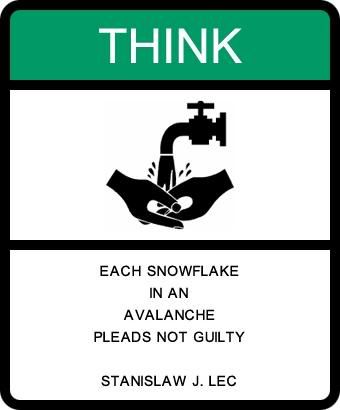

John Chandler has other widgets too, like a street sign and tombstone generator. Scroll down to the bottom of the page to check them out.
Tuesday, June 24, 2008
Warning Sign Generator - Two Quotes
John Chandler has other widgets too, like a street sign and tombstone generator. Scroll down to the bottom of the page to check them out.
Friday, June 20, 2008
Rabbits, Lions, Giraffe Hair, Oh My!
|
Thursday, June 19, 2008
Thursday, May 29, 2008
Archaic Vision
(SWEV-uhn) noun Dream; vision. [From Old English swefn (sleep, dream, vision).]
"[The queen] went in to the Sultan and assured him that their daughter had suffered during all her wedding-night from swevens and nightmare." The Arabian Nights (translated by Richard Francis Burton); 1885.
Friday, May 16, 2008
by the mag @ mental_floss magazine - May 15, 2008 - 7:58 AM
This is the most delightful line in an article about how the bicycle help speed women's liberation in the United States. Apparently the sight of inappropriate, uppity, bike riding wenches drove some of the locals crazy.
Can you imagine riding your bike to the store and having strangers throw things at you. Well, at least the ladies had to worry about it. The working women were allowed a greater range of activities.
Susan and her fellow 19th-century women had been severely trammeled their entire lives. Forget the glass ceiling; women in those days were trapped under the glass floor. Battles like “equal pay for equal work” were decades away. The Victorian woman’s cause was more along the lines of, “We’d like to leave the house, sometimes … please … if it isn’t too much trouble.”
The fashion for women at that time tended toward helplessness and frailty. Consider the image of a Victorian lady: She’s sickly and pale, relies on men for everything, and occasionally peeks out from behind an ornamental fan (usually before touching her wrist to her forehead and fainting). The frailty of a “lady” was such that preventing females from studying, working, voting and doing much of anything at all seemed a rational measure.
Obviously, there must have been some inclination that at least part of this frailty was socially projected. A gentleman taking a trip to the market must have come across dozens of hardworking women from the lower classes. In fact, he may have employed one such woman to support the proper ladies at his home while they gossiped, blushed and passed out. But men didn’t see those hardworking females as proper ladies. A proper lady was seen as weak, defenseless and entirely dependent on men.
In a way, bicycles were the gaming systems of the late 1800s and early 1900s. So many people changed the way they entertained themselves, bicycles had a financial impact the horse, theatre and restaurant industries.
By the late 1880s, the bicycle’s popularity really took off. For instance, in 1880, a group of early cycling advocates called the League of American Wheelmen had a membership of 40; by 1898, its ranks had bloated to nearly 200,000. Cycling was so popular that in 1896 The New York Journal of Commerce estimated bicycling was costing theaters, restaurants and other businesses over 100 million dollars per year. Considering the way the bicycle was exploding in popularity, it was only natural that women should get in on the act.
Before bicycles came along, the horse was the best means of individual travel. Of course, women’s access to horses was limited. Horses were dangerous and difficult to control; conventional medical wisdom suggested that riding them could damage a woman’s genitals. Women were supposed to ride sidesaddle, with both legs hanging off one side. In that unnatural position, women were unable to ride for long distances, reinforcing the idea that they shouldn’t be riding at all.
Bicycles, by comparison, were easy to manipulate. There was no reason a woman couldn’t get on a bike and sedately pedal farther from her home than she’d ever been before. No reason, that is, other than her cumbersome attire and the convention that if she did so, she’d either have her virtue corrupted or die of exhaustion.
The bicycle inspired a fashion revolution when it first came out. Today, bicycles inspire other social protest actions.
The bicycle continues to endear itself to free thinkers. Even today, it’s the centerpiece of many reform movements. Jacquie Phelan (pictured, I saw her race in events on TV), for instance, is a feminist mountain biker who founded WOMBATS, the Women’s Mountain Bike and Tea Society. A three-time world champion voted one of the 10 best mountain bikers of all time, Phelan is a tireless warrior in the fight for equality. She advocates two prices for bikes based on the 59 cents women make to every dollar earned by a man. (She was inspired to take action when she finished sixth in a race and was mistakenly given the $400 dollar men’s prize instead of the $42 allotted to the female finisher.)
As the bicycle continues to lend itself to causes of all kinds, it is important to remember its first battle. Liberating is a word easily associated with cycling. Flying down a tree-lined road with the wind in your face is certainly a liberating experience, but for early female cyclists, a simple bike ride was liberating in a much more significant way.
Another contemporary cause is encouraging people to take up bicycling to help the environment.
We promote the bicycle for everyday use because we see bicycling as a central solution to the environmental, health, and social problems facing our planet.
As the world becomes more aware of the climate problems caused by pollution from the transportation sector, the Silicon Valley Bicycle Coalition points to bicycling as a very clean and healthy transportation solution.
Yesterday, I volunteered as a greeter at The Silicon Valley Bicycle Coalition, Bike to Work Day Bike Away from Work Bash event at Gordon Biersch in downtown San Jose. Most of the volunteers and organizers were women. Over a century later, the bicycle is still inspiring women for social causes.
Steampunk Introduction
Steampunk bursts through its subculture roots to challenge our musical, fashion, design, and even political sensibilities
Von Slatt (a pseudonym) recently blogged about his PC on the Web version of his Workshop (steampunkworkshop.com), detailing the process of its construction and the unique modifications he’d included. Given all of this, it’s hardly surprising that he has been lauded as a kind of tinkerer visionary, a man with the mechanical prowess (he’s an IT professional by day) and artistic skills to solder technology with craftsmanship and form a new artisanal DIY movement. THE VISIONARY TINKERER: With help from OfficeMax and his local town dump, Jake von Slatt turned his 21st-century PC into a Steampunk marvel. STEAMPARK: Seattle five-piece Abney Park claim to be the crew of an airship, The Ophelia. FOR RICH NAGY, a/k/a Datamancer, whose laptop is pictured below, Steampunk is a way to make technology “fun again.” scaled-down 16th-century galleon |
Sunday, May 04, 2008
Steampunk Drove Me to San Mateo Maker Faire 2008
By far, The Crucible was the best booth at the whole faire. Not only was it a fire breathing fire truck (see second picture above) but it made a huge boom that scared me out of my skin more than a dozen times. You could actually feel the air moving if you were at the booth. Whether you were in sight of the Crucible truck or not, you'd hear a boom then people screaming as they got scared. It kind of reminded me of a dragon even though it looked like a regular truck. The Crucible's amazing "ERV" Educational Response Vehicle, or "Fire" Truck, was a platform for demonstrating welding, torch cutting, blacksmithing, and glass flame working workshops. For only $5, Faire goers could sketch out a design on a 6 inch x 6 inch x 1/2 inch plate and some people in welding masks would cut out the design and make a stand for it. There were covered holes in the screen so you could see the welders in action. There was also a glass blowing area where you could watch glass blowers make things behind a clear plastic yellow screen. Above is my mutant clubs and diamond creation. It's very heavy and very rough. The Do It Yourself stuff wasn't limited to hardware. For $5 bucks, I made my own glycerin based, cinnamon smelling soap at the Get Soapy booth. It's supposed to be blue but it came out greenish. That's an upside down lamb in the middle, it's feet are barely showing. I guess to be more artistic, I should have laid the toy on it's side. I wonder if it will scratch when I use it. Next time. The Dark Room exhibit hall was stuffy, relatively quiet but very dynamic. The Crucible was pretty close by outside the entry doors, so you go from the sound of random cannon shots to quiet but not still darkness If you don't move, people coming in run into the back of you. Hundreds of people were jammed into a small space so dark we could hardly see enough to avoid stepping on each other. The only islands of light were the exhibits. In other words, a very cool experience. My favorite booth had hand cranked bicycle-wheel kinetic sculptures. Monkeylectric calls their LED light creations a fusion of kinetic and digital arts. The Busycle was a cool contraption I'd like to see being used in reality. Kind of reminds me of the gadgets they had in The Flintstones. If the digital technology age is called cyberpunk and neo-Victorian technology is called steampunk guess you could call the Flintstones technology age, rockpunk. No particular exhibit. I just loved the contrast of the Victorian dress and the homemade air crafts in The Hangar exhibit hall. They were there to support The Neverwas Haul, a self-propelled 3-story Victorian House made from recycled material. I was almost to the steampunk area next to the festival stage when I saw they were about to let loose the Life Size Mousetrap. It's a huge, Rube Goldberg type contraption based on an old board game. Some Mousetrap characters were dressed as mice (old west saloon girls) and some as something else. I forgot what role these in orange suits guys were. Unfortunately, there were so many people, all I could see was hair and backs. Those two pictures above are from me holding the camera above my head, clicking the button and hoping for the best. I'm happy I got something. The Neverwas Haul was directly next to the Mousetrap, so I got a good look without too many people around. Later, I got pictures of them repositioning the house by steering with the big ships wheel. The people dressed as Victorians were also parking directors. They had the orange road crew flags and everything. I missed the 4 pm Steampunk talk which was disappointing since it was one of the main reasons I came to Maker Fair. I got one picture of Jake Von Slatt of The Steampunk Workshop before I took a Kettle Korn break. He's holding a retro style keyboard based on a brass finished keyboard he showed off on his site. It has the old late 1800s typewriter style keys but it's a standard QWERTY key layout with separate number pad. Even though it's a little heavier than standard plastic, pressing the keys has a nice smooth feel and the felt backing is nicer to the finger touch than a regular keyboard from your neighborhood Fry's or online at eBay. Jake's buddy Doc makes a whole line of custom keyboards including ones with wood backing or specialized alphabets. Very Nice. Onyx Ashanti was a unique busker. Nothing less than you'd expect at Maker Fair. His style is live laptop Beatjazz a few steps up in sophistication from the standard sidewalk musician. Just the way he describes himself sounds so cool.